People have probably brought all sorts of gifts into the Oval Office over the years. Paintings. Football helmets. Signed books. Maybe even golf clubs.
Still, the Stanley Cup is hard to overlook.
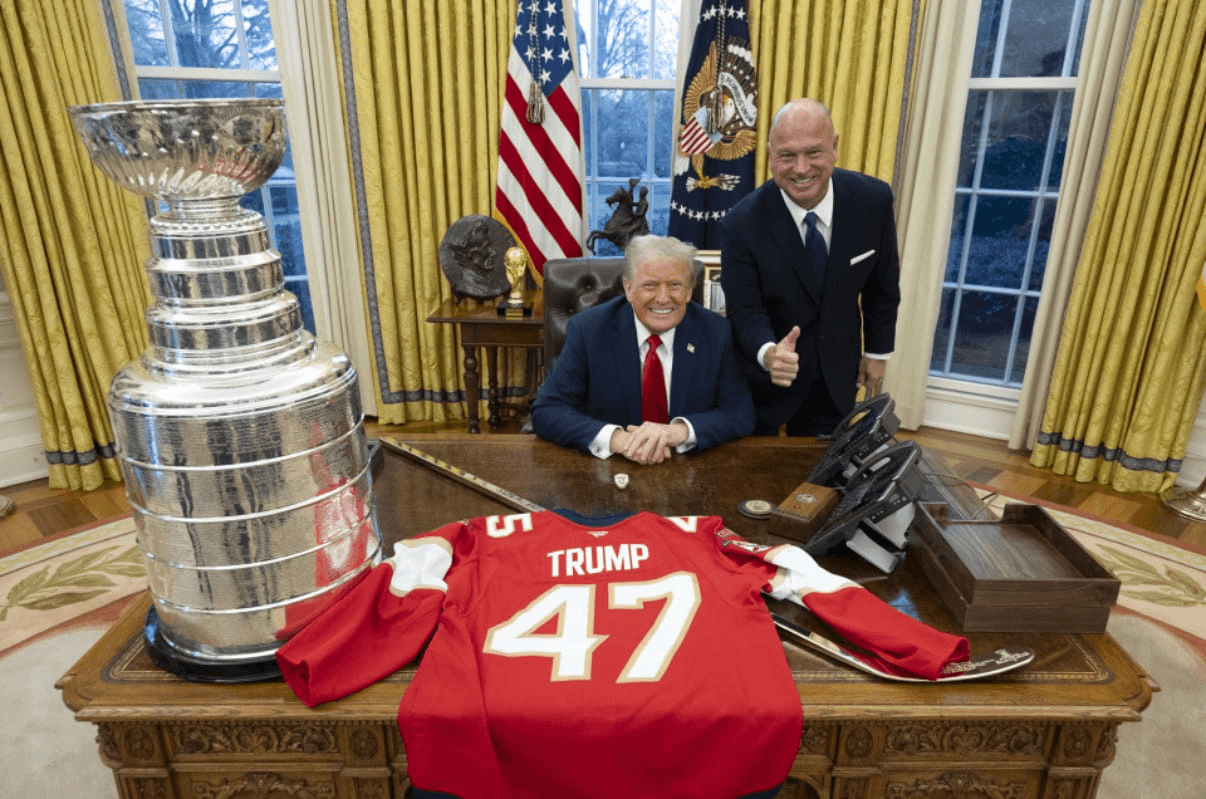
In this photograph, the famous trophy occupies almost as much space as anyone else in the room. It sits near the Resolute Desk, towering over everything around it, while a bright red hockey jersey stretches across the front edge. The name on the back reads “Trump,” and below it is the number 47.
Behind the desk, President Donald Trump smiles toward the camera. Standing just over his shoulder is David Urban, leaning slightly forward with a thumbs-up and a smile that suggests this was a moment nobody wanted to pass up.
It’s not the kind of picture people usually associate with the Oval Office.
There are no stacks of papers. No world leaders. No serious expressions. No one appears to be in a hurry. Instead, it looks like one of those brief pauses that happen when visitors gather, somebody says, “Hold on, let’s get a picture,” and everyone laughs for a second before returning to whatever they had been doing.
And then, just like that, a photograph is taken.
The room itself remains unmistakable. The gold curtains. The tall windows. The presidential flags. Americans have seen those details in countless images over the decades. Even people who know little about politics would recognize the setting immediately.
Yet the Stanley Cup steals attention.
Maybe that’s inevitable.
It has always been one of those trophies that carries its own mythology. Players kiss it. Fans line up to take pictures beside it. Teams spend years chasing it. Seeing it inside the White House creates a strange combination of two different worlds that don’t often share the same stage.
The jersey lying across the desk adds another touch. Somebody obviously thought ahead. It wasn’t folded away or tucked under an arm. It became part of the picture itself. Bright red against dark wood. Impossible to miss.
David Urban, meanwhile, seems perfectly at ease. His expression gives the photograph a lighter mood. It doesn’t feel posed in the traditional sense. There is energy to it. Almost the feeling of someone enjoying the occasion rather than trying to create a perfect portrait.
Sometimes those are the pictures people end up keeping.
Not because they were historic. Not because they marked a major announcement.
Simply because they captured a moment.
Looking closely, smaller things start to stand out. The telephones are on the desk. The fading daylight outside the windows. The presidential seal. A few decorative pieces in the background. Little details people might miss at first glance.
That’s often how photographs work. You notice one thing immediately, then another later.
Maybe somebody will remember the jersey. Someone else will focus on the trophy. Hockey fans will probably spot the Stanley Cup first. Political observers will notice the setting.
Years from now, nobody may remember exactly what time this picture was taken or what was happening immediately beforehand.
But they’ll remember the image.
A president behind the desk. David Urban is smiling beside him. A championship trophy standing almost absurdly tall. And a red jersey spread across one of the most famous desks in the world.
Not a scene anyone sees every day.